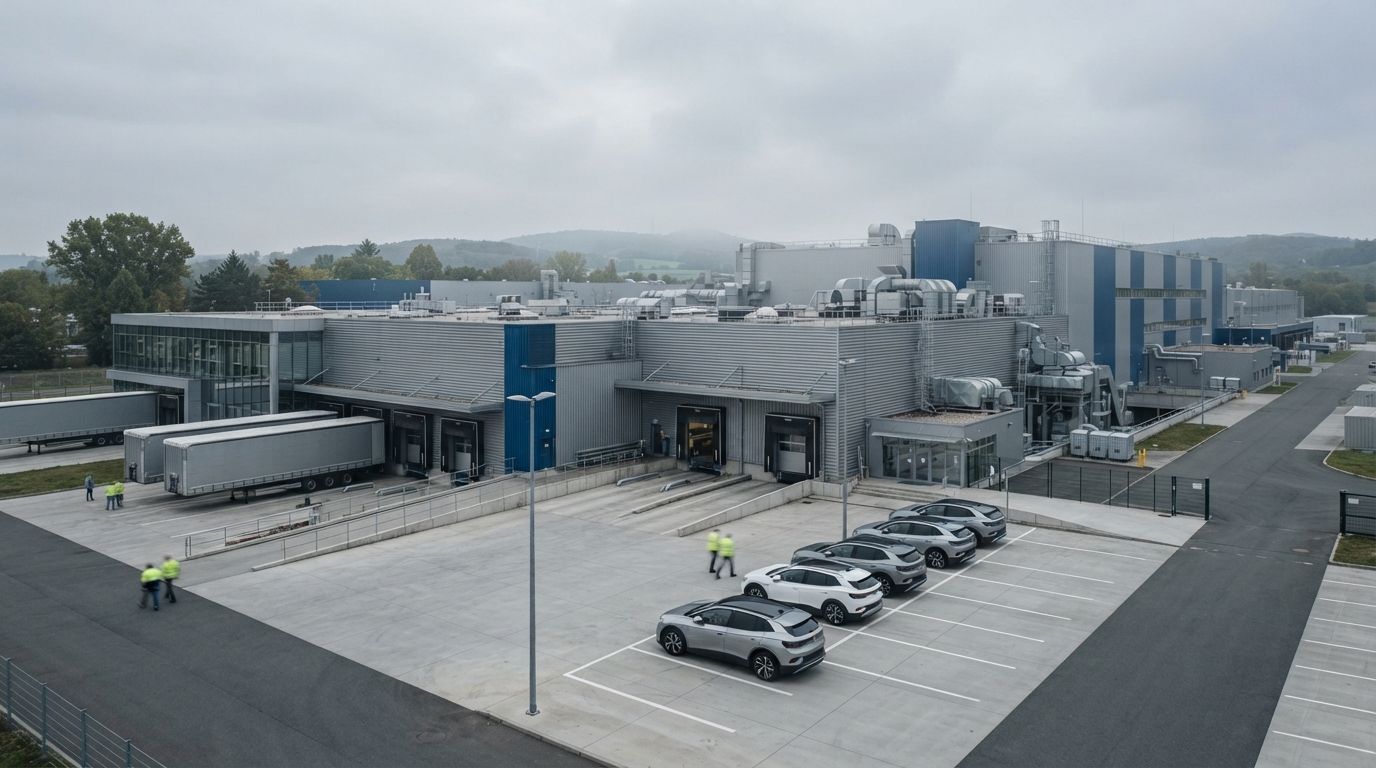
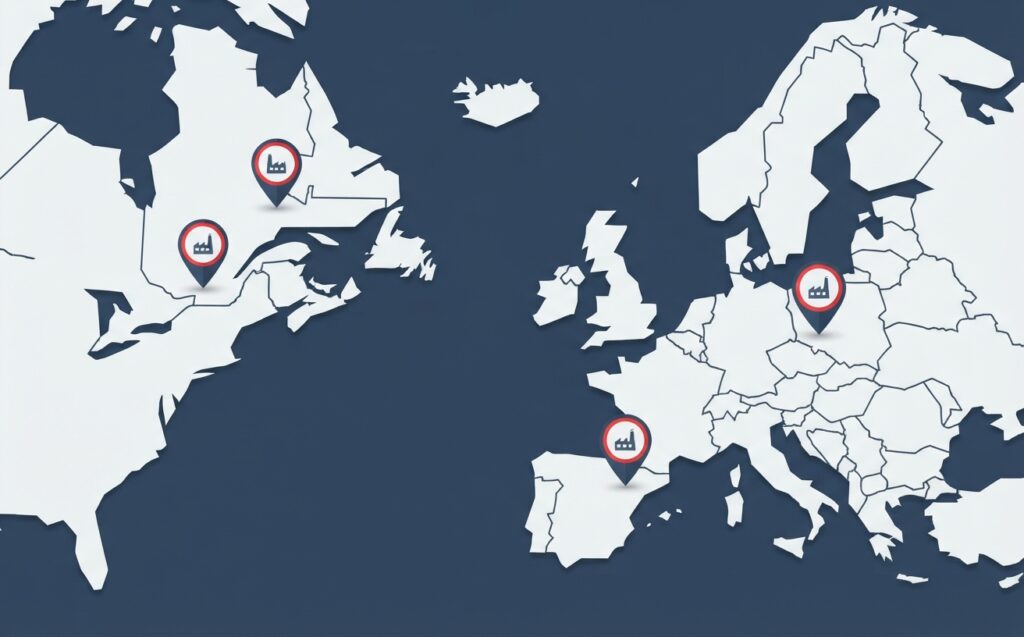
In 2026, several storylines are converging on one theme: Chinese capital is filling capacity that Western automakers no longer want. In Barcelona, Chery is already building vehicles at the former Nissan plant. In Dresden, BYD is in talks for part of Volkswagen’s landmark “Transparent Factory.” And in Canada — the development most directly relevant to North American buyers — a new quota allows up to 49,000 Chinese-built EVs into the country each year, with BYD already the first Chinese automaker cleared through Transport Canada’s pre-market registry.
These aren’t three unrelated headlines. They’re the same process playing out on three separate regulatory fronts: overcapacity in China’s EV industry is looking for outlets in markets that are simultaneously shielding themselves with tariffs and sitting on idle industrial capacity they’d rather not write off.
For readers in Canada and the US, the quota is the part that shows up on dealer lots first. But it reads more clearly against what’s happening in Spain and Germany — all three follow the same tariff-and-capacity logic, just at different stages.
Canada — Quotas, Regulation, and BYD’s First Moves
Since March 1, 2026, Canada has run an import quota for Chinese-built EVs: 24,500 units for the first half of the year (March 1–August 31), with a second tranche of the same size — plus any unused volume from the first period — running from September 1, 2026, through the end of February 2027. In total, the quota allows for up to 49,000 vehicles a year at a 6.1% tariff, replacing the 100% surtax that applied previously. Permits go to Canada-registered manufacturers on a first-come, first-served basis and are valid for 60 days.
BYD has already moved on the opening this quota created. The company registered its Shenzhen and Xi’an plants in Transport Canada’s Appendix G registry — the pre-clearance mechanism confirming compliance with Canadian Motor Vehicle Safety Standards (CMVSS) — making it the first Chinese automaker to clear this step for passenger vehicles. The plants in question build BYD’s mass-market models: Dolphin, Seal, Atto 3, and Seagull. That’s a direct play for the mid-price segment of Canada’s EV market, not a low-volume halo launch.
Registration alone doesn’t guarantee sales volume — it’s clearance, not an allocation — but it gives BYD a head start of several months over rivals still working through the paperwork. Since permits are issued first-come, first-served rather than proportionally, speed through the regulatory process is now a direct competitive advantage. On the policy side, Canada’s Industry Minister Mélanie Joly confirmed meetings with BYD and Chery representatives in January 2026, with Ottawa signaling it expects Chinese brands to localize manufacturing in the country within roughly three years.
Spain — Chery and the Former Nissan Plant in Barcelona
Nissan’s Barcelona plant (Zona Franca) closed in 2021, putting thousands out of work. Its restart runs through a joint venture between Spain’s Ebro and China’s Chery: the site is already assembling Ebro-branded vehicles, while Chery prepares to launch its own production — the Omoda 5 and Jaecoo 7.
The timeline has slipped more than once. Production was originally planned for late 2025, then pushed to 2026; trial assembly is now expected in the third quarter of 2026, with full-scale output by year-end. The delays have been attributed to commercial factors, including the need to adapt to EU tariffs on Chinese-made EVs.
Localization will deepen in stages: assembly starts as SKD (semi-knocked-down kits) before shifting to CKD (more deeply localized component assembly). The partners have stated a target of up to 150,000 vehicles a year by 2029, positioning Barcelona as one of Chery’s key export hubs — including for shipments to Latin America. For the region, this is fundamentally a jobs story: the closure of a plant that was an industrial fixture in Barcelona left a real gap, and while the current lineup and suppliers are different from the Nissan era, the restart formally answers the question of what happens to the site.
Germany — BYD’s Interest in VW’s Dresden Plant
This part of the story is still unconfirmed, and it’s worth flagging clearly as such. According to CarNewsChina (May 2026), BYD is in talks to use part of Volkswagen’s “Transparent Factory” in Dresden, which has sat idle since VW ended vehicle production there at the end of 2025.
The arrangement under discussion would split the site roughly in half: one part becoming a research and innovation hub for the Dresden University of Technology (TU Dresden), the other going to BYD for EV assembly. The talks are early-stage, and BYD isn’t the only Chinese automaker eyeing VW’s spare European capacity — MG and Xpeng have reportedly also shown interest.
Volkswagen CEO Oliver Blume gave the arrangement some public backing on April 30, 2026, saying that using idle European capacity together with Chinese automakers could be a “clever solution” for cutting costs and addressing VW’s own overcapacity. For BYD, a German manufacturing address would help on two fronts at once: lower tariff exposure and a higher-profile production base in Europe’s largest car market. Even at this preliminary stage, the fact that Volkswagen is publicly discussing leasing plant space to a direct competitor says something about how quickly the competitive landscape has shifted — this would have been an unlikely scenario for a flagship German plant even a year or two ago.
Why This Is Happening: US Tariffs, Chinese Overcapacity, and the Search for Workarounds
Three factors converged at once and are reinforcing each other.
First, the US market is effectively closed: tariffs on Chinese EVs run as high as 100%, making direct export there commercially pointless.
Second, China itself has persistent overcapacity and brutal price competition among dozens of manufacturers that domestic demand alone can’t absorb — a structural problem for the industry, not a temporary glut.
Third, local assembly has become a direct workaround for tariff barriers, not just a marketing gesture. The EU has applied differentiated countervailing duties since October 2024, on top of the standard 10% import tariff: 17% for BYD (27% combined), 18.8% for Geely (28.8% combined), and 35.3% for SAIC (45.3% combined). Assembling inside the EU either removes a model from these duties entirely or sharply reduces the burden. Canada’s case shows the same mechanism working in reverse: the tariff cut from 100% to 6.1% was traded for a quota system and an expectation of eventual local production.
Despite the tariffs, the expansion hasn’t slowed. BYD registered 135,307 new vehicles across the EU, UK, and EFTA markets between January and May 2026 — up 145.2% year over year — and in January 2026 the brand cracked the top three EV sellers in Europe, trailing only Volkswagen and BMW.
What It Means for the Market and Consumers
For consumers, the near-term effect is a wider choice of EVs in the mid-price segment and added downward pressure on prices: localized Chery and BYD models don’t carry the full tariff burden and can compete more aggressively on price than imported equivalents. For Canadian buyers specifically, the practical question is timing — how fast BYD and Chery can convert regulatory clearance into actual dealer inventory once the quota windows are live.
The employment picture is mixed. Barcelona’s plant restores some of the jobs lost when Nissan closed, while the Dresden scenario, if it goes ahead, envisions splitting capacity rather than restoring VW’s former headcount there.
For incumbent automakers — Volkswagen, Nissan, and others — the situation cuts both ways: leasing out idle capacity to Chinese partners turns a stranded asset into revenue and cuts the cost of maintaining it, but those same partners become direct competitors using that same production base.
The regulatory track — EU tariffs, Canada’s quota, and likely future localization requirements — will keep determining which Chinese brands establish themselves through actual local production and which stick to smaller-scale partnerships. What’s confirmed today is what’s already on paper: Chery’s Spanish plant and Canada’s quota with BYD’s registration. The Dresden case remains a negotiation and is worth tracking as it develops.